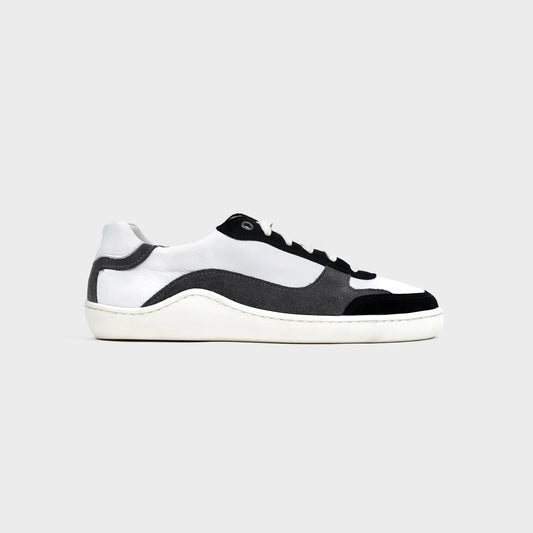

What is Evolved Barefoot?
Evolved Barefoot goes beyond zero drop. Discover the 3 pillars behind Bareo's approach to barefoot footwear, engineered for real posture, not just freedom.
Updated: 05 August, 2026

For years, barefoot footwear has been defined by one rule above all others: zero drop. No heel elevation, no interference, nothing between the foot and the ground. It became the gold standard of the category, and for good reason. It freed feet from decades of artificial support.
But freedom on its own does not always give direction.
Evolved Barefoot starts from the same foundation as classic barefoot design, and then asks a different question. Not just how do we get out of the way of the foot, but how do we help the foot do its job better. That single shift in thinking is what separates a barefoot shoe from an Evolved Barefoot shoe.
The Problem With Treating "Barefoot" As One Thing
Barefoot is often talked about as a single, fixed idea. In practice, it is a spectrum. A shoe can respect every structural principle of barefoot design, the wide toe box, the flexible sole, the absence of artificial arch support, and still make very different choices about how it supports the foot once those boxes are checked.
Most of the conversation stops at the sole. Evolved Barefoot starts there and keeps going. For a deeper technical breakdown of where the line sits, see our full Barefoot vs Podopostural comparison.
The Three Pillars of Evolved Barefoot
An Evolved Barefoot shoe is built on three components working together, not one specification working alone.
1. Anatomical shape. The toe box is wide enough for toes to spread naturally under load, the way they would on bare ground. This is non-negotiable in any barefoot shoe, classic or evolved.
2. A minimal, purposeful sole. Evolved Barefoot uses a low, deliberate drop of 4mm rather than an absolute zero. It stays within the range the biomechanics literature treats as barefoot or extreme-minimalist, close enough to the ground to preserve proprioception, the foot's ability to read the terrain, while introducing a controlled incline designed around how the foot actually moves through a step.
3. A podopostural insole. This is the pillar that most barefoot shoes skip entirely. Instead of a flat, neutral surface, the insole is shaped to support the hallux, the big toe, in its natural role as the guide of the step. Classic barefoot design leaves the foot completely alone. Evolved Barefoot leaves the foot free, but not unguided.
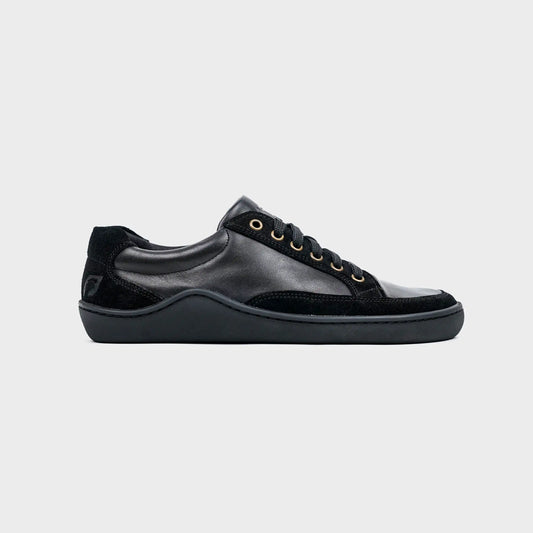
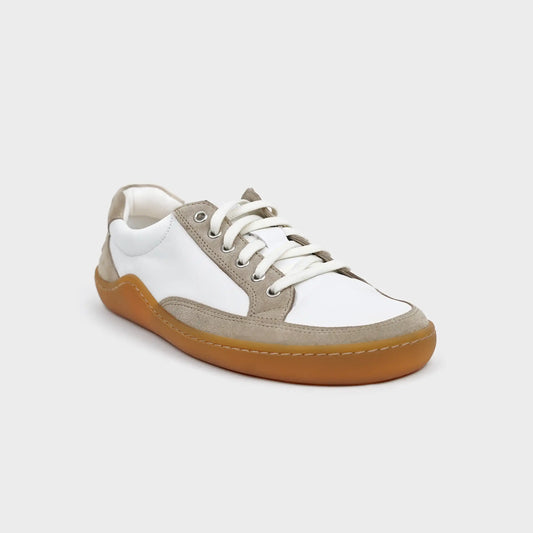
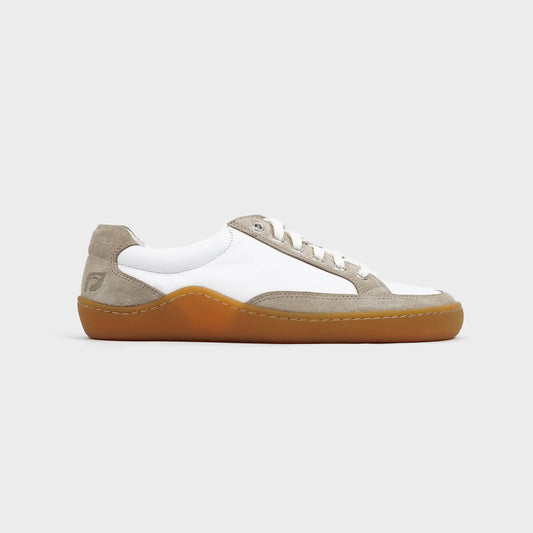
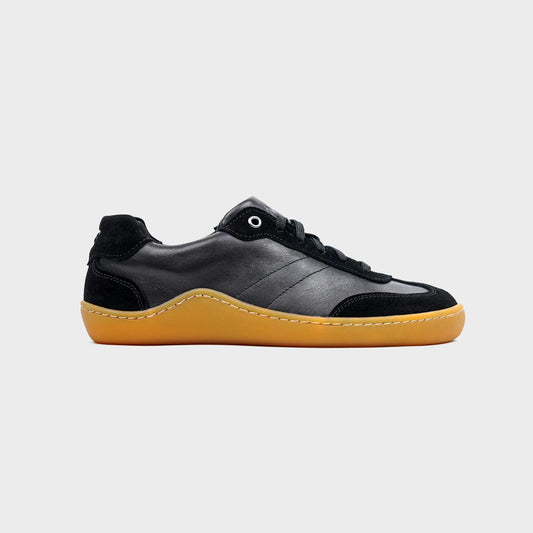
Any one of these pillars on its own is not enough. It is the combination that defines the category. An Evolved Barefoot shoe balances functional biomechanics with refined design, combining a 4mm drop and podopostural support with premium Portuguese leather craftsmanship built for everyday elegance.
Why Not Just Zero?
Zero drop is often treated as an endpoint, the purest possible version of a barefoot shoe. It is a valid and rigorous standard. But zero is a number, not a philosophy. It tells you what a sole does not do. It does not tell you what the shoe does instead.
Evolved Barefoot treats the drop as one variable among three, not the entire definition. A 4mm drop sits at the upper edge of what is generally considered the barefoot and extreme-minimalist range, still far removed from the elevated heels of conventional footwear, and it exists specifically to work in concert with the podopostural insole rather than in isolation. It is enough incline to help guide the step without ever reintroducing the artificial heel lift that barefoot design set out to remove in the first place.
This is also why Evolved Barefoot is not positioned as a stricter or purer version of barefoot. It is a different question with a different answer, built for people who want the freedom of barefoot and the guidance of a shoe engineered around how their foot actually moves. If you're transitioning from conventional footwear, see our guide on making the switch to barefoot shoes.
The Hallux as a Guide, Not Just a Digit
Most conversations about barefoot shoes focus on what the shoe removes: cushioning, arch support, elevated heels. Evolved Barefoot focuses on what a specific part of the foot does when it is properly supported.
The hallux acts as the guide of the step, the reference point the rest of the foot follows through stance and motion. When a shoe design compresses or misaligns it, commonly through a narrow or upturned toe box, that guidance function is disrupted, and the rest of the foot compensates. A podopostural insole is shaped specifically to protect this function, rather than leaving it to chance the way a flat, neutral sole does.
This is the detail most barefoot design never addresses, because most barefoot design stops at removing interference rather than asking what proper support looks like.
Evolved Barefoot vs Classic Barefoot
|
Classic Barefoot |
Evolved Barefoot |
|
|
Goal |
Remove interference between foot and ground |
Remove interference and guide natural movement |
|
Drop |
Absolute zero (0mm) |
Functional micro-drop (4mm) |
|
Insole |
Flat / Neutral |
Podopostural (hallux-guided) |
|
Toe Box |
Wide / Anatomical |
Wide / Anatomical |
|
Philosophy |
"The foot needs nothing" |
"The foot needs freedom and direction" |
|
Best For |
Barefoot purists / natural terrain training |
Everyday life, long hours standing, elegant transition |
Neither approach is wrong. They are answers to different questions. Classic barefoot asks how little a shoe can do. Evolved Barefoot asks what a shoe can do well, without ever betraying the barefoot principle in the first place.
Barefoot Wasn't the Destination
Barefoot design solved a real problem. Conventional footwear had spent decades doing too much to the foot, cushioning it, elevating it, boxing it in, until the foot forgot how to do its own job. Barefoot took all of that away and let the foot remember.
Evolved Barefoot takes that same starting point and asks what comes next. Not more material, not more support in the conventional sense, but direction. A shoe that stays out of the way and still knows where the step is going. Every pair is designed around this principle and made entirely in Portugal, from leather and suede sourced and worked locally. See our production story.
Barefoot removed everything in the way. Evolved Barefoot adds the one thing that was missing: guidance.
Frequently Asked Questions
-
Is Evolved Barefoot the same as minimalist footwear?
No. Minimalist footwear typically describes shoes that reduce material and structure without necessarily including a podopostural insole. Evolved Barefoot is a more specific category defined by the combination of anatomical shape, minimal purposeful drop, and hallux-guided insole design.
-
Does a 4mm drop disqualify a shoe from being barefoot?
No. The biomechanics literature generally treats drops up to around 4mm as within the barefoot or extreme-minimalist range, with impact on gait considered minimal. Beyond that point, into the 4-8mm range, footwear moves into minimalist rather than barefoot territory. A 4mm drop sits right at the edge of the barefoot range, as a deliberate design choice rather than a compromise.
-
Is zero drop always the better choice?
Not necessarily. Zero drop is the right choice for people specifically training toward barefoot purism or working within very controlled, gradual programmes. For most people transitioning from conventional footwear or spending long hours on their feet in everyday life, a minimal, purposeful drop paired with postural guidance can be more supportive without sacrificing barefoot principles.
-
What makes an insole podopostural?
A podopostural insole is shaped to support the natural position and function of the hallux as the guide of the step, rather than being flat and neutral like most barefoot insoles. It does not cushion or correct in the way a conventional orthotic does. It supports alignment from the base of the foot upward.