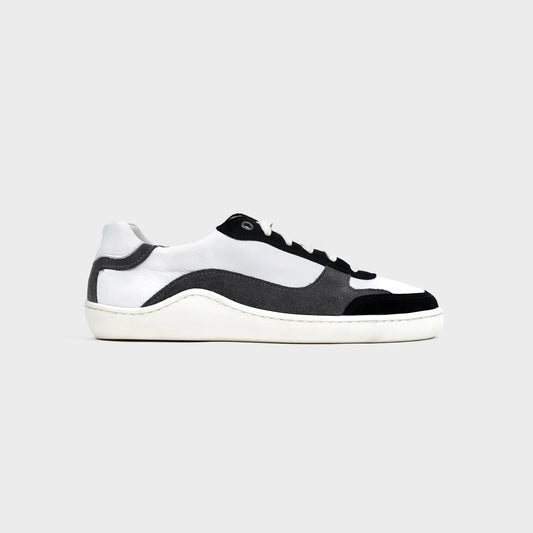

13 mistakes when switching to barefoot shoes
Most problems people associate with barefoot shoes don't come from the shoe itself, they come from how the switch is made. Here are the 13 most common mistakes, and how to avoid them.
Updated: 15 September, 2026

Most of what people associate with barefoot shoes going wrong doesn't come from the shoe itself. It comes from how the switch is made. A good pair of barefoot shoes, poorly introduced into a routine, can create exactly the same discomfort a poor pair, well introduced, would have avoided.
It's also worth remembering this change isn't just about the feet. Muscles, tendons, and joints along the whole leg start working differently, so the adaptation happens in the body, not just in the footwear.
Here are the most common mistakes, and what to do instead.
1. Replacing everything overnight
Swapping out all your everyday footwear for barefoot shoes in the first week doesn't give muscles and tendons the time they need to adapt. It's probably the single most common mistake, and the main reason behind most "I tried it and it didn't work" stories. A gradual transition, starting with a few hours a day, consistently works better.
2. Choosing the wrong drop for your starting point
Zero drop and micro-drop aren't different degrees of "more or less barefoot," they're two answers to different starting points. Someone coming from years in conventional footwear generally finds a more comfortable transition with a 4mm micro-drop than an immediate jump to absolute zero. Choosing based purely on "purer is better" ideology, without considering your own starting point, is a common and avoidable mistake.
3. Going straight into intense activity
Buying barefoot shoes and breaking them in on a long walk, an intense workout, or a full day on your feet asks your feet to suddenly do work they don't yet have the strength for. Even physically active people benefit from starting in short, predictable contexts before increasing demand.
4. Starting to run too soon
Running changes how the foot strikes the ground, and therefore how the calves, Achilles tendon, and sole absorb impact, in a more demanding way than walking. Moving straight into running before the body has had time to adapt to comfortable walking is asking too much, too fast. Walking comfortably first, and only then introducing short runs, tends to avoid most of the discomfort tied to this mistake.
5. Ignoring early tiredness instead of adjusting pace
Some tiredness in the calves and arches during the first few weeks is normal, it's the body working differently. Pushing through that tiredness instead of reducing wear time for a few days is one of the most common reasons people give up too early, not because the shoe was wrong, but because the pace was.
6. Choosing the wrong size or fit
Even the best barefoot design loses value if the toe box is too tight or the heel too loose. Unlike conventional footwear, where there's some margin for error in fit, barefoot shoes depend on a proper fit for the toes to spread naturally. It's worth confirming fit with extra attention rather than assuming your usual size.
7. Keeping tight shoes on for the rest of the day
Wearing barefoot shoes for just an hour a day and spending the rest of the time in narrow-toed footwear sends the foot two opposite signals at once. It doesn't cancel out the benefits of barefoot shoes, but it makes adaptation slower and more confusing for the foot. Where possible, pairing this with wider-toed footwear for the rest of the day helps keep the process consistent.
8. Comparing your pace to someone else's
Adaptation can take anywhere from a few weeks to a few months, depending on each person's history. Comparing your progress to someone who adapted in two weeks, when your starting point is different, creates unnecessary frustration and has nothing to do with whether your own transition is going well.
9. Testing uneven terrain too soon
Walking on flat, predictable ground is easier to adapt to than uneven terrain, loose stones, or highly variable surfaces. Starting in demanding environments before your feet have had time to rebuild strength and proprioception can make the first few weeks unnecessarily uncomfortable.
10. Ignoring an existing health condition
Not every situation calls for the same caution. If there's a condition like neuropathy, a recent surgery, or an acute pain flare-up, the decision about when and how to make this transition should be made with a healthcare professional, not decided alone through trial and error.
11. Underestimating the role of insole design
Not every barefoot shoe does the same thing for the foot once interference is removed. A podopostural insole, for example, gives the hallux a reference point to guide the step from day one, rather than leaving the foot entirely on its own. Overlooking this difference when choosing footwear can mean missing out on support during exactly the phase where it helps most.
12. Giving up in the first difficult week
The first week is, for most people, the most uncomfortable part of the whole process, and also the easiest one to quit during. Most "it didn't work for me" stories happen precisely in this window, before the body has had any real chance to adapt. Getting through that initial phase, even with pace adjustments, usually makes all the difference to the final outcome.
13. Not varying use contexts gradually
Wearing barefoot shoes only at home, or only on the commute, without ever introducing other contexts, slows down overall adaptation rather than protecting it. The goal isn't to avoid variety, it's to introduce it progressively, home, then short outings, then longer days, rather than staying stuck in a single context out of fear of discomfort.
The pattern behind almost all of these mistakes
Notice that almost none of these mistakes are actually about the shoe itself. They're about pace, context, and expectations. That's not a coincidence, it's the most common pattern in any change that asks the body to work differently. The right shoe helps, but it doesn't replace a well-managed transition.
Frequently asked questions
-
How long should I wait before increasing how much I wear barefoot shoes?
There's no universal number, but most people benefit from increasing gradually over several weeks rather than large jumps overnight. -
Is it normal to feel discomfort in the first few weeks?
Mild tiredness in the calves and arches is common. Sharp, persistent pain, or pain that worsens with rest, isn't normal and is a reason to reduce wear and see a professional if it continues. -
Should I start with zero drop or micro-drop?
It depends on your starting point. People coming from conventional footwear tend to adapt more comfortably to a micro-drop before considering absolute zero, but both are valid depending on the individual. -
Can I alternate between barefoot and conventional shoes during the transition?
Yes. Many people find a more comfortable transition by alternating between the two at first, rather than switching completely overnight. It helps if the conventional footwear worn during that period has as wide a toe box as possible. -
Can I keep exercising while I transition?
Yes, but it's generally more comfortable to keep more intense activity in your usual footwear until your feet are further along, introducing barefoot shoes first in more predictable, everyday contexts.
Discover the Bareo Evolved line → Explore the collection